Showing posts sorted by relevance for query pinochet. Sort by date Show all posts

Monday, June 10, 2013

DeLong's Law

I would like to propose DeLong's Law, a corollary of Godwin's Law: In any blog thread mentioning Hayek or Friedman, the probability of Chile/Pinochet being cited approaches one, as time passes.
Posted by: George Zachar on July 10, 2003 05:08 AM
The above was posted, as a reminder, to Brad DeLong's 'obituary' of Milton Friedman of January 2012.  One of the odd aspects of DeLong's personality being that, at the same time that he censors opinions that contradict his on his blog, he is capable of an objective analysis of Friedman's work.  Even though he and Friedman voted differently--DeLong served under Lloyd Bentsen in Bill Clinton's Treasury Dept.--he admired Friedman both as an economist and as a man:
Thinking as hard as he could until he got to the root of the issues was his most powerful skill. ....
His world-view began with a bedrock faith in people, in their ability to make judgments for themselves, and thus an imperative to maximize individual freedom. On top of that was layered a deep faith and conviction that free markets were almost always the best and most magical way of coordinating every conceivable task. On top of that was layered a powerful conviction that a look at the empirical facts--a marking-to-market of your beliefs to reality--would generate the right conclusions. And on top of that was layered a fear and suspicion of government as an easily-captured tool for the enrichment of cynical and selfish interests that sought to grab whatever they could. Suffusing all was a faith in the power of argument and the utility of reason. He was an optimist: people could be taught the truths of economics, and if they were properly taught then institutions could be built to protect all against the corruption and overreach of the government.
Which many of DeLong's acolytes absolutely can't stand to see.  For example:
thomas said...
Meanwhile, to Chileans, he represents privatization, dismantlement of social safety nets and grinding poverty. Friedman may have been smart, but he was a useful idiot for not only for dictators and their public relations but more importantly for multinational corporations. 
Which is pretty much what Jamie Galbraith had to say, just weeks ago. 'thomas' doesn't give a source for what he says 'Chileans' think about Friedman, nor why, but with the recent publication of James Rolph Edwards' Painful Birth: How Chile Became a Free and Prosperous Society, it's getting increasingly silly for such sentiments to be expressed in supposedly respectable intellectual venues. Not that that will prevent it continuing.

What Prof. Edwards has managed to do, in a mere 69 pages, is destroy the argument that Augusto Pinochet was, in any way, a net negative for the overwhelming majority of Chileans.  Whatever role Milton Friedman played in Pinochet's thinking--they once met for 40 minutes in Santiago, and Friedman wrote him a follow-up letter on his advice, given through interpreters, about how to control the savage inflation devastating Chile in 1975.  Advice that Friedman also gave to Communists in Yugoslavia, Russia and China.

As has been related on this blog in several earlier posts, Chile, in 1973, was in chaos.  A Castro-ite ideologue, Salvador Allende, was attempting to, with no legal justification whatsoever, transform the country into a Marxist dictatorship.  Understandably, the people of Chile objected, and when Allende defied them, the military acted. Rock...hard place.

Either a permanent Marxist dictatorship supported by Fidel Castro--who'd sent his agent Manuel Piñeiro to Chile to help Allende organize his security and intelligence services--or the military junta headed by Pinochet, were the stark choices. Constitutional democracy was no longer available--in fact Allende had a plan to abolish the Chilean legislature and replace it with "a people's assembly". He'd already created torture chambers to be used against his enemies (that later were used against his supporters). The Chamber of Deputies in Santiago had voted to censure President Allende in August of '73 for acting unconstitutionally, and called for the military to act against him.

They got Pinochet...and...eventually a free and prosperous society. By the standards of Latin America, at a very low cost.  Yes, there was some excess brutality as the Pinochet regime fought the armed militias left behind by the suicide Allende, but since over 700 military and policemen lost their lives in the firefights that occurred, it's hard to show that any other tactics would have worked as well.  Allende had established a guerrilla warfare training camp in southern Chile stocked with weapons from Cuba and the Soviet Union. Pinochet's forces fought to defeat those forces for years (in 1976 1,200 guerrillas attempted to infiltrate from Argentina.  In 1986 they killed 5 of Pinochet's bodyguards and almost killed Pinochet, with a rocket attack on his motorcade).

Yet, Pinochet allowed a plebiscite on his regime to go forward in 1988, and when he lost that vote, he voluntarily stepped down. Unlike any other dictator in Latin American history.  Fidel and Raul Castro still rule Cuba as dictators.

More will follow (from Prof. Edwards) about just how Pinochet accomplished the transformation, in a later posting.

Saturday, February 28, 2015

Was Augusto Pinochet a Villain or Hero for Chile?

For the PanAm Post, it is still unresolved, apparently. Some even denying that Pinochet and Chile had any real enemies;
I was born in Chile, and lived under Allende and Pinochet. So according to you, then I saw things all wrong and I never saw anyone get arrested or killed, and the truth commissions currently being held in Chile now are all lies and communist propaganda.
Next you will quote me from the NY Times that Victor Jara was never murdered by Pinochet-he staged his death so he could move into a house with Elvis in the Bahamas, and that Contreras is innocent and that DINA was not a murderous secret police, but really just a late night food delivery service. Next you will tell me no prisoners were ever held by Pinochet at the National Stadium in Santiago and show me the FIFA report to confirm this. Villa Grimaldi was just a country club and that elections were held every year when Pinochet was in power and that he never tried to stage another dictatorship the night he lost the plebiscite.  You are truly delusional.
 Javier (the author of the above comment) seems determined to miss the point that no one disputes that people get killed during wars. And did in the civil war in Chile after the overthrow of Salvador Allende's Wanna-be-like-Fidel regime. One wonders who Javier thinks the people fighting Pinochet were, peaceful demonstrators petitioning for redress of grievance?

No, in most cases they were armed and dangerous Marxist guerillas. Whether they called themselves MIR, ERP, Tupamaros or Montoneros, they were armed and trained in Cuba or by Cubans to destabilize not only Chile, but Bolivia, Peru, Ecuador, Colombia, Argentina and several other countries. There were thousands of them in Chile before and after the military overthrew Allende in 1973.

Back in October of 1970, just after Salvador Allende was named as the winner of the Presidency in Chile, there was this exchange on William F. Buckley's Firing Line, among the host and his guests Selden Rodman and Georgie Anne Geyer--who knew Allende so well that she used to go swimming with him and his Cuban girlfriend at the Veradero Beach Club in Havanna almost every day when the both lived in Cuba in 1966 (transcript from the Hoover Institution);
Mr. Buckley: But does Allende, himself, allude to the Cuban situation -- does he say, I want to make things the way they have them in Cuba?
Miss Geyer: Very often.
Mr. Buckley: Yes.

Miss Geyer: When I was there in June, he gave a speech and said very clearly -- I was there -- he said, when I'm elected, we will have the revolutionary axis between Havana and Santiago. And, whenever I have talked to him, which is a half-dozen times over the years, he has always made it very, very clear -- that I don't think there is any --well, his admiration for Fidel is almost worshipful. And, at times....
Mr. Rodman: When the exiles from Che's adventure in Bolivia escaped into Chile, Allende took them personally by plane to Havana, because he thought that they were the heroes of his movement.
And those heroes returned to fight Pinochet again and again. Even into the 1980s, as they almost succeeded in killing Pinochet with a rocket attack on his motorcade in 1986.

Hey, Augusto, take it like a man!, says Javier.

Tuesday, June 11, 2013

Ignoring Milton's advice in Chile

In his very useful book Painful Birth: How Chile Became a Free and Prosperous Society, James Rolph Edwards gives Augusto Pinochet a great deal of credit for transforming Chile into the peaceful prosperous country it is today. And it is certain unusual for a career military man--since the age of 15--who takes power in a coup to move a country to a liberal democracy.  Much less one with a free market economy.

Restoring feudalism has been more common in Latin America, and also more in line with traditional military thinking; command and control from above.  Rank hath its privileges. So it is remarkable that Pinochet, almost from the beginning, seems to have been determined to not only eliminate the Marxism that Salvador Allende had unconstitutionally (the Chilean Supreme Court and Chamber of Deputies' judgments) imposed on the Chilean people, but to distance Chile from its social democratic past--it was the Eduardo Frei Christian Democrat party that had begun the wave of partial nationalization of agriculture and industry in the 1960s.

Even before the Chicago Boys economists were appointed to positions in the Chilean government, before Pinochet met with Milton Friedman for forty minutes in March 1975, the direction was clear.  As Pinochet wrote to Friedman in a letter dated May 16, 1975, thanking him for his letter from the previous month detailing the steps Friedman advocated for Chile; The valuable approaches and appraisals drawn from an analysis of the text of your letter coincide for the most part with the National Recovery Plan proposed by the Secretary of the Treasury, Mr. Jorge Cauas. The plan is being fully applied at the present time--a plan for which we have the high expectations of advancing the Chilean economy.

Jorge Cauas, a Christian Democrat, studied economics at Columbia, not the University of Chicago, and had been in the government since July 1974.  One of Cauas' policies though, was in direct contradiction to advice that Friedman gave in his letter--the elimination of wage controls, which Friedman called one of the worst parts of the disease. And Cauas idea--the legal imposition on Chile's businesses of an obligation to index wages to the previous years's inflation rate--had huge negative effects for Chile.

With an inflation rate of several hundred percent per year, that meant something far worse than sticky wages failing to adjust downwards in the recession that inevitably follows a slow down in the rate of money creation by the central bank. It meant that wages were legally mandated to rise in a recession. One hardly needs to be a Chicago Boy to see what is wrong with that.

That one concession--for the most part, as Pinochet put it--to organized labor in Chile produced a persistently high unemployment rate well above what would have occurred had Milton Friedman's advice been taken.  A rate that gave an opening to left-wing critics of Pinochet and the Chicago Boys that was exploited for years by them, and still is by the likes of Naomi Klein.  Had Pinochet actually taken Friedman's advice for shock treatment, he would have had an easier time explaining the benefits of his National Recovery Plan.

Fortunately, other aspects of that plan were better thought out.  As we shall see.


Wednesday, May 29, 2013

Is Jamie Galbraith Humane

Of all the economists behaving badly at the Milton Friedman symposium at Econ Journal Watch, surely none exceeds the poor form of the one who titles his contribution Mistah Friedman? He Dead.

Whatever would possess anyone with scholarly pretensions to begin that way--implying Friedman was a slave master?--when discussing the man who is arguably the greatest economist of the 20th century can't be admirable. Then to recycle an easily refuted slander is even worse;
We may surmise that Friedman’s affinity for first principles were behind his support for the Chilean dictator Augusto Pinochet, a man who granted freedom—and life itself—only to those who dared not oppose him. Here was a grisly contradiction between “economic freedom” and the real thing. My impression is that Friedman did his best to ignore Pinochet’s crimes, and then made up excuses when he had to. This is perhaps harsh. But it’s a more generous view than the alternative, which is to believe that he thought the socialists, communists, poets and musicians in the National Stadium got what they had coming.
First, Friedman was not in any way a supporter of Augusto Pinochet.  The charge of him being so is made up  almost out of whole cloth. Friedman, while in Chile for a speech at Catholic University in Santiago which was not sponsored, nor even associated with the Chilean government, agreed to meet with the General to discuss with him, for approximately forty minutes, the options he had for controlling the virulent inflation in his country.

Inflation (running to around 700% per year in mid 1974) bequeathed to Chile by the man Pinochet deposed, Salvador Allende Gossens.  By taking Friedman's advice Chile's economists managed to cut that to 10% in about a year three years. Truly a good deed done for the citizens of that country. This history is easily ascertainable; it's related in the Friedmans' memoir, Two Lucky People, including a copy of the letter Friedman wrote to Pinochet as a follow up to his meeting with him.  So Galbraith has no excuse whatsoever for his claims.

Nor should we excuse Galbraith's attempt to pretend that Pinochet didn't have real (and deadly serious) enemies; socialists, communists, poets and musicians. That phrasing is designed to obscure that the people who had been in power before Pinochet's coup were attempting to transform Chile from a republic into a Castroite dictatorship. They weren't really making much of an attempt to hide what they were doing, so Galbraith should know that fact as well.

If he doesn't, he could find out by reading the chapters in Georgie Anne Geyer's Buying the Night Flight, that concern her dealings with both Castro and Allende when she lived in Cuba. He'd see that when asked by Geyer if, when after he was in office there would be any more elections (as there weren't after Castro took power in Cuba) Allende told her;  'You don't understand. Everything will be different then.'

Which brings us to the real reason Galbraith probably feels the need to slander Friedman; it can be found in the essay Is Capitalism Humane, written in 1978 and included in Bright Promises, Dismal Performance: An Economist's Protest:
When you hear people objecting to the market or to capitalism and you examine their objections, you will find that most of those objections are objections to freedom itself.  What most people are objecting to is that the market gives people what the people want instead of what the person talking thinks the people ought to want.  That is true whether you are talking of the objections of a Galbraith to the market, whether you are talking of the objections of a Nader to the market, whether you are talking of the objections of a Marx or an Engels or a Lenin to the market.
The Galbraith referred to in the above being Jamie's more famous father J. Kenneth.  But the apple didn't fall far from the tree.  It's the same arrogance that allows him to ignore what the common people of Chile were suffering under Salvador Allende, because Allende was a socialist, a communist, maybe even a poet or musician.  The Galbraiths' kind of people.  There are never too many excuses to be made in the name of class solidarity. As for the riff raff, they should just suffer what they had coming.

Thursday, June 13, 2013

Chile's 'dirty secret'

In this 2010 audio interview with Canadian journalist Eleanor Wachtel, novelist Alberto Fuguet says that Augusto Pinochet's legacy is that he made the country more 'modern, open, liberal...very liberal.'  He was, 'A gift from our elders who tried to change the country [into Marxism]. They didn't change it, he did.'

The new Chile is one where 'People feel empowered. That they can have a future. They can make their own future, and also be part of the world.' Between Wachtel and Fuguet, it's agreed that's because Pinochet 'de-politicized' the country. Now young people don't even bother to register to vote. They don't want to. Unlike before the military coup when everything was up for grabs politically.

Earlier in the interview Fuguet had described the early 70s in Chile as, like 'a family fight' between members of the Chilean bourgeois; the kids of  lawyers and doctors.  It was definitely not the people, the proletariat, who wanted to make changes, but 'all rich kids'.

With Pinochet being like a step-father who has married your mother.  He comes from somewhere else and decides he has to impose order on the family that has become disorderly. Later commenting, 'The right won and maybe the biggest shock is they're not bad.'

Another amusing observation from Fuguet being that when Pinochet stepped down, a lot of left-wing papers that were good and had done well when Pinochet was available as an enemy, folded after he was gone, as they had nothing to write about anymore. Similarly, a 'new art' came into being.  The old art was political, 'Art was a cause.' After that cause went away, it opened up opportunities for writers of non-political work. 

Which brings us to a critic of Pinochet, Milton Friedman, who in two speeches given in Santiago in March 1973, warned young Chileans about their dictator.  He describes it in Two Lucky People;
I...talked on the fragility of freedom, emphasizing the rareness of free societies...and the role in the destruction of a free society that was played by the emergence of the welfare state. ...that their present difficulties were due almost entirely to the forty-year trend toward collectivism, socialism, and the welfare state, that this was a course which would hurt people not help them, and that it was a course that would lead to coercion rather than freedom....from their reaction [my argument was] obviously almost completely new to them. There was an attitude of shock that pervaded both groups of students at hearing such talk.
Was Pinochet listening to Friedman? 

Saturday, September 14, 2013

Jack said it

Some people just can't handle the truth;
There are calls for a senior New South Wales Liberal MP to be reprimanded over a speech defending the late Chilean dictator Augusto Pinochet.
The State Government's Upper House whip, Peter Phelps spoke in State Parliament to mark the 40th anniversary of Pinochet's overthrow of Chilean president Salvador Allende.
"There are many who believe that General Pinochet was a reluctant hero, a morally courageous man," Dr Phelps told Parliament.
"We have to accept that sometimes it's necessary to do bad things to prevent terrible things.
"It's all too easy to say we believe we should never sanction dictatorship or that we should have no truck with evil, but such principles are foolish and self defeating in the real world.
"Yes, Pinochet killed people and if you know of any way to overthrow a government other than military force then let me hear about it."
In the aftermath of the 1973 coup d'état several thousand of Pinochet's political opponents were killed and tens of thousands more tortured and imprisoned.
The torture chambers had actually been constructed by Allende to be used against his opponents. After his overthrow some elements in the army turned them against the Marxists (many of them foreigners inserted into Chile after being trained by Fidel Castro's men). Which may have been unnecessary, un-Christian, or worse, but Chile didn't have any good options open to it in 1973.

What is indisputable is that Chile is incomparably better off today than it would have been had Allende remained in power. And, it is a democracy, which it wouldn't be if Pinochet hadn't acted, as Allende had plans to abolish the Chilean legislature.

Unfortunately, Mr. Phelps, can't handle the whole truth himself, as he was forced to backtrack;
"At no time did I defend the regime and indicated my disgust at the number of people who'd been killed by him."
There's a lot to defend, and, as we've pointed out before, the best defense is in James Rolph Edwards little book, Painful Birth; How Chile Became a Free and Prosperous Socierty

Saturday, January 12, 2013

'No' es una tontería

Preguntas they forgot to ask before this historia was written;
Chile is getting its first shot at an Oscar for best foreign-language film, along with global attention and a boost to its thriving film industry with the nomination of “No.”
....“No” revisits a publicity campaign that helped oust Gen. Augusto Pinochet from power after 16 years as a dictator.
Gael Garcia Bernal plays Rene Saavedra, a formerly exiled advertising hot shot drawn into a 1988 referendum TV campaign who tries to persuade people to vote “No” to eight more years of Pinochet.
would be, 'Could this have happened if Salvador Allende had not first been over thrown by Pinochet?'

Because Allende didn't make any apologies to journalists (such as Georgie Anne Geyer) who asked Allende about there being any more elections once he was in office:  'You don't understand.  Everything will be different then.'

There certainly weren't any elections on whether or not Allende's idol Fidel Castro would continue in office in Cuba, and still aren't.  So Chileans owe a big debt to Augusto Pinochet, who peacefully left the country to its destiny--which seems to be to continue to prosper as it had when he was 'dictator'-- when he saw he wasn't popular.

But, a story of how Pinochet had to fight to rid his country of a petty tyrant who was destroying Chile (one of the most prosperous South American countries until Allende took power); it's economy as well as its democracy, wouldn't get anywhere with Hollywood, and its fervent leftish denizens.

Monday, June 17, 2013

Chile in the 80s, and beyond

When last we left our continuing review of James Rolph Edwards' Painful Birth: How Chile Became a Free and Prosperous Society, Chile had recovered from a serious recession in the mid 1970s and was enjoying annual real GDP growth of almost 7%. As we mentioned, Chile's path wasn't always smoothly upward, and a mistaken monetary policy tactic--pegging the Chilean currency to the US dollar in 1979--was a disaster waiting to happen.  Which it did after Paul Volcker slammed on the monetary brakes in the United States in 1981 in order to break the inflationary spiral that had developed in the U.S.

The side effect of the cure for inflation being recession. The higher the inflation, the worse that recessionary side effect. With Chilean monetary policy being determined by the Federal Reserve in the USA, and Chile's inflation rate being much higher than that in Volcker's country, Chile's recession was much more severe than America's. It hit in 1982-83, and was brutal.  GDP dropped over 13%, as once again demand for Chilean copper dropped drastically, as it had in 1975.

The Chilean public was understandably outraged, and Pinochet had to make some changes in his economic team, including sacking the Minister responsible for the currency peg. The Chilean peso was freed from the U.S. dollar, tariffs were again lowered, more corporations were privatized,  double taxation of corporate profits was eliminated and rates were lowered.  Maybe most importantly, the law requiring wages to be indexed to the prior year's inflation was eliminated.

Even more innovative--Chile, like many Latin American nations had borrowed heavily in foreign markets, and many firms were on the brink of default--the Chicago Boys instituted a program of  equity (stock) swaps of that debt.  As Prof. Edwards tells it:
As a policy, it worked extremely well, contrary to the predictions of the critics. In 1982, Chile had a foreign debt burden equivalent to $17.4 billion in U.S. dollars, one of the highest per-capita in the world.  Yet in only four years, 1985-1989, $10.5 billion of this debt was retired, mostly thought various forms of debt-equity swap, and the country had built up $9 billion in foreign exchange reserves. Exports expanded and the country prospered.
Chilean productivity boomed and real GDP grew at a compound rate over 6% for the rest of that decade. In stark contrast to what was happening to all other Latin American nations during this time. Nor, contrary to left wing spin, was the increased prosperity confined to the better off in Chile.

Finally, the last gift from Pinochet to his nation was the restoration of democracy.  Losing a plebiscite in 1988 that would have given him another decade in power, Pinochet stepped down.  Even though in doing so he knew he was going to be opening himself to retaliation by disaffected socialists.  And not just in his own country.  When, elderly, he traveled to the United Kingdom for medical treatment in 1998, a Spanish court issued a warrant for his arrest on the dubious grounds that Spanish citizens had been murdered in Chile when he had been president. Pinochet's last years were spent defending himself from that, and other charges.

But, as it says on the plain marble slab that covers the remains of the architect Christopher Wren in the basement of St. Paul's Cathedral in London, If you need a monument, look around. Chile has been a functioning democracy for about a quarter century now. Even when Socialist governments were elected they didn't attempt to undo the free market reforms of Pinochet and his Chicago Boys--one such Socialist, Ricardo Lagos, still brags that he privatized the Pan American highway!

Chile has a sound (privatized) social security system, school choice for even its poorest students, freedom from the fear of the midnight knock at the door that was the fate of most people who suffered the kind of nightmare that Salvador Allende wanted to impose. Quite a monument if one isn't afraid to look around...and see.

Friday, February 14, 2014

The paranoid Pinochet had real enemies

Somewhat surprising that the left-wing Santiago Times wants to go here;
A Chilean judge has called for the extradition of former leftist guerrilla Marie Emmanuelle Verhoeven, aka  “Comandante Ana”, over her suspected role in planning the 1991 assassination of Sen. Jaime Guzmán, a prominent figure in Gen. Augusto Pinochet’s regime.
On Jan. 27 Verhoeven was detained in Germany and now Chile hopes to bring her to trial on the decades-old charges.
....It is believed Verhoeven was at one point a leader within the Manuel Rodriguez Patriotic Front (FPMR), an armed leftist guerrilla group that sought to overthrow Gen. Augusto Pinochet’s military dictatorship. The FPMR first gained notoriety in 1986 when guerillas attempted to assassinate Pinochet, narrowly failing to kill the general but leaving five of his bodyguards dead in the process.
Yes, imagine that. Die hard murderous Allendeans operating in Chile into the nineties. Even after Chile exited the Junta and became a democracy with free elections.

There might be something to ponder there.

Thursday, May 30, 2013

Una historia verdadera

Accepting Cicero's challenge (via Paul David), and to counter a decidedly untrue story from Jamie Galbraith (via Anthony Lewis of the NY Times) we visit an old PBS interview with Arnold Harberger for some facts about Chile and the Chicago Boys;
[The story of the University of Chicago Economics Dept's involvement with Latin American students] began with Theodore W. Schultz, who was a very great economist, won the Nobel Prize, was president of the American Association and so on, and he, in the early '50s...
I.e., long before either Salvador Allende or Augusto Pinochet had any power in Chile.
...he had a major project entitled Technical Assistance to Latin America.... On a visit to Santiago, he had dinner with the then-AID [Agency for International Developlment] director, Albion Patterson...and when Patterson heard Schultz talk, he said, "This is the kind of idea that Chile needs,"....so Patterson got the idea of a university-to-university link between a Chilean university and the University of Chicago....we trained under that program itself around 30 Chileans, many who became later ministers and Central Bank presidents and things like that. But that set in motion a whole tradition of Chilean students coming to Chicago.... Meantime, we had a similar program started by the same Albion Patterson in Argentina. ...afterwards we had a continuing flow of Argentines, and by this time Mexicans, Brazilians, and so on were mingling in so that Chicago, in its heyday, had 40 to 50 Latin American graduate students out of a total stock of, say, 150 to 180, so they made up a very important part of the program. ... Now Latin American students can get in almost anywhere because they have shown how good they are, but in those days, they were viewed with such suspicion that it was lucky if you could find three or four at Harvard at any one time or five or six in MIT, when you could find 40 or 50 in Chicago. That is what gave Chicago such importance in the Latin American scene. 
Gee, the name Milton Friedman hasn't even come up yet.  So let's skip to the entrance from stage left of the Castro-dolator Salvador Allende;
INTERVIEWER: Tell me a bit about Chile.... Allende gets elected....
AL HARBERGER: Well, Allende...as a politician of the Socialist Party, and he ran as the candidate of a left-wing coalition. Many people were surprised at the degree to which his policies, once in power, were policies that might have been explainable if he'd had a 65 percent majority, but [not when he only got a little over a third of the vote in a three way contest]....
That's how 'democratic' Allende's election was.  The Chilean people split the majority of their vote nearly equally between two non-socialist parties, and the socialist (actually Castroite Communist) snuck in to office.
 What happened [after Allende was in office] was a huge move toward socialization of the economy. There were many actual expropriations of enterprises, including the major mines, but in addition to that, there was a thing that they call intervention, which is a little bit like what we have as receivership for a bankrupt firm [where] the court appoints a person to run the firm and it isn't the owner. Well, in the Allende system, you could do that on any firm, whether it was bankrupt or not. (laughs) And by the time the Allende period was halfway through, about 90 to 95 percent of the main Chilean industrial sector had been either nationalized or intervened.
I.e., Allende expropriated the property of ordinary Chileans and, though Harberger doesn't say this, when he couldn't legally accomplish the abolition of private property he encouraged mobs to rampage throughout Chile to intimidate landowners into abandoning their property (source; Georgie Anne Geyer's Buying the Night Flight).
INTERVIEWER: ... And what was happening to the huge inflation?
AL HARBERGER: All the things got way out of hand. I don't know how things would have been if the Allende government had had decent economic advice, but they did kind of silly things. They put controls on all the prices while mounting a monetary policy that led to enormous inflationary forces. There was a point in time when there were 13, I believe, official exchange rates to the dollar. The cheapest dollar was 25 escudos, and the most expensive official dollar was 1,300 escudos, but the black market was like 1,800 at that time. You see, it was just a crazy world. The black-market prices of goods, which are usually quoted about a 20 percent premium or a 10 percent premium over the official price, they never talked that way, six times the official price, seven times, 10 times, five times. That's how it worked, and so the market was just out of function, you see. It was not working at all.
INTERVIEWER: So one other question: The CIA intervened, particularly with the [strikes].... Would you say that the economy was sabotaged by the U.S.?
AL HARBERGER: The U.S. was on that side, [and] I don't think there can be any doubt that the majority of Chileans were on that side at that moment in time.
Which means that Augusto Pinochet came to the rescue of the majority of Chileans--and after being invited to do so by Chile's Chamber of Deputies. But we're still not finding Milton Friedman playing any role here, so let's skip ahead;
INTERVIEWER: Tell me about that time Milton Friedman made his famous visit to Chile?
AL HARBERGER: Oh, Milton Friedman's visit took place in March, I believe, of 1975, and his judgment about the economy was not in any sense unique. I mean, it was what any good economist, looking at the Chilean economy at that time and seeing that kind of a mess, would say. But I think that Milton's presence probably helped to maybe stiffen the spine of people who were trying to insist on better economic policies. Maybe his remarks convinced some people that would otherwise not be convinced that this kind of change was needed.
Pinochet's coup deposing Allende took place in September 1973. So, the needed change Harberger is talking about is away from the policies of the Pinochet military government. Harberger's description of the status quo at that time being;
...inflation...was like 400 percent in 1974-'75, and it got down under 100 percent, I think for the first time, by '78 or '79, and it got down to 10 percent only in '81.....
INTERVIEWER: Of course Milton Friedman especially then became a kind of a kind of hated figure, didn't he? ....Why do you think people [hated] him?
AL HARBERGER: Well, it's a hard story there. The left wing of the world loved Allende. Allende was the first socialist elected in a Latin American country as I remember, that actually took office anyway, and he was the darling more of the European left than the American left, but we always in the United States had what we call radical student groups like SDS [Students for a Democratic Society] who took their cues from the European left, so these are the people for whom Milton Friedman then became a figure of hate. They organized demonstrations against him wherever he went, and this went on for a period of years, and I see nothing that he did to deserve that. (laughs) And he [faced it] with such courage and such strength of character, I marvel to this day at the way he took that.
Again, Harberger doesn't mention this (he may not be aware of it) but most of the demonstrations against Friedman were instigated by Yuri Andropov's KGB; it was disinformation swallowed, hook, line and sinker, by the likes of Anthony Lewis and Jack Anderson back then (and still, now, by Jamie Galbraith).
INTERVIEWER: But going back to those demonstrators, still [there's a sort of] question on Milton Friedman, because of this association. I'm not saying that it's right or wrong, but just why do you think their people are so horrified?
AL HARBERGER: Well, as I say, I think that the whole response picture to Chile has to be linked to somebody loving Allende and somebody being terribly disappointed when Allende was put out of office. Now I think if you look at human rights violations or political violations, you will find them in any Asian country almost at that time, in multiples of whatever was happening in Chile and in Latin America. You would find many other countries in which the same sort of thing was happening and was not getting that treatment, so my question, and the reason for my answer in connection with Allende, is... Allende is what distinguishes the Chilean case from all these others. I mean, Milton Friedman went to Chile for one week. You can take the top 100 economists in the country of that time, and probably 85 of them had been working seriously in places like Korea, Taiwan, Pakistan, Bolivia, Paraguay -- you name it -- and were not getting any demonstrations.
INTERVIEWER: One of the points Friedman was making was that these kind of free-market policies ultimately lead to a freer political system. In other words, was he sort of suggesting that the free-market policies would ultimately undermine Pinochet's [regime]?
AL HARBERGER: Oh, I think he always said that. He said that that you cannot have a repressive government for long within a genuinely free economic system and that the freedom is going to have to pass over to the political side, and that of course, is exactly what did happen in Chile. The evolution took quite a number of years to make, but it happened, and in that sense, Chile is an example of a peaceful transition from [authoritarianism] to a civilian democratic government.
So, the only role Friedman played with regard to Chile was to first briefly advise the government (about a year and a half after it took power) how to control a virulent inflation, and to argue that Chile needed freedom and democracy. Chile should put up a statue of Friedman in their most prominent plaza.

Wednesday, August 13, 2014

DeLong and the shortage of primary sourcing


 Professor J. Bradford DeLong persists in his strange habit of ascribing beliefs to Friedrich von Hayek, without any attempt to produce any of Hayek's actual writings mentioning Augusto Pinochet. So here's some actual evidence of what Hayek thought; 
[Editor, Times of London]
Sir,

Though I can scarcely expect you to find space in your columns for the instruction Mr William Wallace (July 24) evidently needs, I shall appreciate it if you can do so for a brief reply.

I have certainly never contended that generally authoritarian governments are more likely to secure individual liberty than democratic ones, but rather the contrary.  This does not mean, however, that in some historical circumstances personal liberty may not have been better protected under an authoritarian than democratic government.  This has occasionally been true since the beginning of democracy in ancient Athens, where the liberty of the subjects was undoubtedly safer under the ’30 tyrants’ than under the democracy which killed Socrates and sent dozens of its best men into exile by arbitrary decrees.

In Modern times there have of course been many instances of authoritarian governments under which personal liberty was safer than under democracies.  I have never heard anything to the contrary of the early years of Dr Salazar’s early government in Portugal and I doubt whether there is today in any democracy in Eastern Europe or on the continents of Africa, South America or Asia (with the exception of Israel, Singapore and Hongkong), personal liberty as well secured as it was then in Portugal.

More recently I have not been able to find a single person even in much maligned Chile who did not agree that personal freedom was much greater under Pinochet than it had been under Allende.  Nor have I heard any sensible person claim that in the principalities of Monaco or Lichtenstein, which I am told are not precisely democratic, personal liberty is smaller than anywhere else!

That a limited democracy is probably the best possible known form of government does not mean that we can have it everywhere, or even that it is itself a supreme value rather than the best means to secure peace, a defensor pacis or instrument of peaceful change of government.  Indeed our doctrinaire democrats clearly ought to take more seriously the question when democracy is possible.

Perhaps they can be induced to reflect on this by pointing to the truism that, except in the direct democracy based on an assembly of all citizens, a democracy can never create itself but must always be the product of the authoritarian decision of a few – and be this only the decisions about the questions to be asked and the procedure to be followed in a plebiscite.  After all, some democracies have been made possible only by the military power of some generals.  And my old doubts whether a democracy can be maintained in a country which has not by different institutions been taught the tradition of the rule of law has certainly been only confirmed by recent history.

Yours faithfully,

F.A Hayek
Urachstrasse 27
D7800 Freiburg (Breisgua),
West Germany
July 26 [1978].
That Hayek couldn't find any single person claiming that personal freedom was greater under Allende than Pinochet, doesn't mean there aren't socialist/communist Chileans  who would have told him so. However, serious scholarship pretty clearly proves that Chile was freer, and eventually more democratic, after the coup led by the Chilean military.

One member of the Hollywood Ten, Edward Dmytryk, told (in his book Odd Man Out) of a strategy session he attended with his colleagues over how to defend their (outrageous) conduct in 1948 before the HUAC. They had refused to answer questions on the dubious basis of a First Amendment right not to speak. One of their lawyers asked them if they would allow fascists a right to free speech. All immediately agreed they would, except for John Howard Lawson:
'It's not that simple'....

'The answer,' he said with finality, 'is that you do not believe in freedom of speech for fascists.' I was a little slow.

'Why not?' I asked. Lawson regarded me as he would an innocent neophyte.

'You believe in freedom of speech for communists,' he said, patiently, 'because what they say is true. You do not believe in freedom of speech for fascists because what they say is a lie.'
QED. Who could argue the logic of that? It was so simple, so plausible, so jesuitical, and so contradictory. All of us had invoked the First Amendment as the basis for our refusal to cooperate with HUAC, and now we were expected to deny its protection to those who might disagree with us. But of course!
We're willing to bet that at least some of the denizens of DeLong's blog would agree with John Howard Lawson.

Tuesday, May 19, 2015

'Fidel was always the first to know what was happening' in Allende's Chile

Says former bodyguard to Castro, Juan Reinaldo Sanchez in his new book The Double Life of Fidel Castro. His source for that was the máximo líder's own intelligence chief La Barba Roja (Manuel Pineiro)--about whom we've written before.

Sanchez provides a few more details to what we've already learned from other sources about the extent of Cuba's role in the supposed martyr, Salvador Allende's Chile. That country, ...at the start of the 1970s was without doubt the country in which Cuban influence had penetrated most deeply. Fidel devoted enormous energies and resources to it.

According to La Barba Roja, says Sanchez, while Allende was not Castro's puppet, Fidel was grooming two Chileans to succeed that socialist presidente when the time came. Fidel's real proteges were Miguel Enriquez, the leader of the Movement of the Revolutionary Left [MRI], and Andres Pascal Allende...nephew of President Allende. Both had been trained in Cuba for that purpose.

Meanwhile Manuel Pineiro and his intelligence services were busy penetrating and infiltrating the entourage of Salvador Allende. Including the head of Chilean public television Augusto Olivares. Also the daughter of the President, Beatriz Allende, was married to a Cuban diplomat stationed in their embassy in Santiago. She managed to convince her father to replace his personal security team with Cuban agents, including the notorious twin brothers Patricio and Tony de la Guardia (later to be sacrificed to a firing squad along with General Arnaldo Ochoa, when word threatened to get out that Fidel was heading a drug smuggling ring).

When the military coup led by General Augusto Pinochet waylaid those intricate plans in 1973, all was lost. Not that Castro didn't have his henchman Barba Roja try to reverse things. Sanchez confirms reports that at the time of the Pinochet-led coup there were hundreds of Chileans getting politico-military training in Cuba's Punto Cero de Guanabo camp. They were eventually sent back to South America to fight the Chilean junta, and almost succeeded in killing Pinochet in a rocket attack on his motorcade in 1986.

The leader of that attack still lives in Cuba today, according to Sanchez's book. 

We do wish that Sanchez had expanded on this remark about La Barba Roja; ...he died in a car accident in 1998, at a time when he was about to embark on writing his memoirs.

Thursday, December 12, 2013

Aprendido nada, nada olvidado

Chilean leftists continue to assault freedom of the press, four decades on;
Another lawsuit has been brought against the owner of Chile’s largest media group, accusing him of “unlawful association” with the dictatorship of Gen. Augusto Pinochet in order to intentionally cover up the torture and deaths of “disappeared” civilians.
We sympathize with the editorial criticism of poorly reported events, but wonder if the shoe was on the other foot the same rules would be applied to a left-wing Presidente's media admirers. Consider;
Rinconada de Maipú refers to a supposed confrontation between Communist extremists and the the the Pinochet-era secret police (DINA) in the hills surrounding the neighborhood of Maipú, Santiago in November 1975. The “confrontation” was covered live by Televisión Nacional (TVN) and Channel 13 of the Universidad Católica over the course of 30 minutes, during which reporters claimed to hear gun-shots ringing from the hills behind them. La Segunda, a part of the El Mercurio conglomerate, later backed the story. 
Specifically, we're curious about that 'supposed confrontation' line, as hundreds of Chilean police and military were killed by 'supposed' Allendeans (up to 12,000 strong) planted in that country, even before 1973 coup, by Fidel Castro's master spy Manuel Pineiro. They were using real bullets in the AK-47s supplied to Allende by Cuba and the Soviet Union (as we've reported in several posts).

With Señora Bachelet leading the polling for next week's election, will the Santiago Times' one day be held to account for its (mis)reporting of her actions in office?

Wednesday, September 11, 2013

9-11-73

Today marks the fortieth anniversary of the military coup that ended the attempt to turn Chile into a Castro-ite dictatorship that Salvador Allende Gossens preferred. As Alberto Fuguet said, Pinochet changed Chile for the better, and that's the dirty little secret; the right wing won, and they turned out to be not so bad.

Unfortunately, some Chileans have forgotten nothing, and learned nothing;
Chile is a country divided, one whose citizens often disagree on the best way to deal with their past. There are those who want to move on and look forward, and others who think society cannot reconstruct itself until it acknowledges what happened on Sept. 11, 1973.
Which was that an overwhelming majority of Chileans wanted Allende removed from office. The Chilean Chamber of Deputies had voted, 81-47, to remove him as President. When Allende made a defiant radio broadcast saying, over my dead body, the military, led by Augusto Pinochet, gave him his wish--he ended his life with an AK-47 he'd received as a gift from Fidel Castro. Today, Chile is one of South America's happiest places.

Cuenta tus bendiciones, amigos.

Wednesday, June 24, 2015

Eso demostración 70s

The staff at the Pan Am Post says, la guerra for oil is Cuba's game in Venezuela;
Studies released by the Institute for Cuban and Cuban-American Studies (ICCAS) at the University of Miami have revealed that the Cuban regime is training Venezuelan paramilitary groups, including Los Tupamaros, La Piedrita, Simón Bolívar, and Alexis Vive. These groups have killed more than 25 students during protests, and injured over 300.

These studies show that for years the Venezuelan government has sent regime supporters to Havana to learn repression tactics in order to help their leaders stay in power. Furthermore, there is evidence that the Revolutionary Armed Forces of Colombia (FARC), a group designated as a terrorist organization by the US government, also trains these groups on Venezuela’s border with Colombia.
This should come as no surprise, as Cuba did this in Chile in the 1970s. There were thousands of paramilitaries trained by Cubans inserted into that country after Salvador Allende became el presidente in 1970. It took Augusto Pinochet over a decade to root them out with the Chilean military. In the process of that dirty war, Pinochet almost lost his own life in a rocket attack on his motorcade.

Fortunately for Chile, the (comparative) good guys won, and Chile became a free and prosperous society. Also, fortunately, Chile wasn't cursed with large reserves of petroleum;
“Cuba has even created a contingency plan in case there is a change of government in Venezuela. They have prepared groups that are ready for action to prevent that change in politics,” lawyer and researcher Pedro Roig asserts.

Roig says Cuba cannot afford to lose the oil they receive from Venezuela — around 50,000 barrels per month, and roughly 100,000 before the economic crisis — and that is why they train these Chavista groups.

“Cuba needs to protect the oil that comes from Venezuela. For Cuba, this is vital, and they are doing what they need to do in order to keep it,” he adds.
The question is, do non-Communist Venezuelans realize what they need to do to free themselves from their nightmare.

Monday, June 3, 2013

Who was Salvador Allende, really?

Continuing from the immediately preceding post, Georgie Anne Geyer begins to realize that there's something rotten in the state of Chile.  Particularly in the southern parts, around the city of Concepcion.  She tells the results of her investigation in Buying the Night Flight;
 ...there was the question of who was supporting and abetting a far leftist activist group called the MIR....This was a group of fanatic leftist guerrillas and activists in the South....In sharp and total contradiction to everything that President Allende...was saying about obeying Chilean law, the MIR in the South was ruthlessly taking over small farms, terrorizing people, and driving out the small middle class and small farmer class that was the backbone of Chile....Allende was angrily denying over and over in Santiago that he was a dangerous Marxist.
Geyer goes to Concepcion and informally meets with the leadership of Allende's Socialist party there.  She asks, directly, of Rafael Merino, if they are behind the tomas (the illegal land takeovers).  Merino, the local party head as well as a professor of philosophy at the university there, freely admits they are. I.e., Allende is lying when he denies it in Santiago.

She then travels all over the province and uncovers more evidence that Allende's Socialist party is indeed behind everything happening.  She talks her way into a prison in the city of Nuble to interview a leader of the MIR named Ugarte.  He tells her, 'We have to exterminate the patrones....Soon the fight is not going to be only for land. Now we are preparing for war. Civil war. The type in Spain or Indonesia.'

She talks to their victims too. They are clearly fearful, willing to meet with her only in secret and looking over their shoulders to see who might be listening.  She visits small--10-12 acre--farms and sees the 'lines of hostile-looking men'.  There is always one spokesman, 'the Socialist organizer'.  She asks rhetorically, 'This was a spontaneous revolution?'

She also says that she saw something else; the Chilean army wasn't ignoring what was going on.  They were hanging back, as long as Chile was still a democracy, but they wouldn't wait forever; 'As awful and as reprehensible as was the rightist dictatorship of Augusto Pinochet, which was to come, anyone who could not see that Allende's policies were leading directly to that certainly knew nothing of political dynamics.'

Noting that, 'Ironically' the traditional Communist Party of Chile wanted nothing to do with Allende's tactics.  They knew what the dynamics would be. 'In the winter of 1972' she's told by Volodie Teitelboim, the 'ideologue and thinker' of the CP of Chile that if Allende continues on his road, there will be a military coup, 'About eighteen months from now'.

That coup came in September 1973. And it happened because the country had completely broken down, it was in the 40th day of a nationwide strike by transport workers who were objecting to Allende's attempted takeover of their small businesses--trucking, taxis.  In addition to the truckers, over 200,000 small shopkeepers, the nation's doctors and dentists, and the housewives were also striking and demonstrating.  Allende was defiant, claiming the only way to get rid of him was 'impeachment'.  Well, not exactly.

One reason Allende might have been so confident was that he'd created a private army 10,000-12,000 strong of foreign Marxists, heavily armed with weapons from Cuba and the Soviet Union.  Those foreign troops were the people Pinochet's forces were after in the wake of the coup.  Jamie Galbraith's  'socialists, communists, poets and musicians.'

[more to come]

Tuesday, August 12, 2014

Then there's Bad DeLong

When he's not being one of the country's most accomplished economists, he uses his imagination, overtime, to slander others (who aren't alive to defend themselves);
And then there is the fascinating (and apparently missing) letter from Hayek to Thatcher, apparently urging that Thatcher go all Pinochet-medieval on Neil Kinnock and Arthur Scargill....
DeLong is admitting that he has never read this letter--'apparently missing'--but passing judgment on its contents; 'apparently urging that'.

Nice work if you can get it. And you can get to it easily if you don't care that you're betraying certain prejudices (because your usual suspects won't tell you they've noticed) on the road to sophism.

Btw, what IS the proper response to Allende-Castro-Stalinism? And would it have accomplished what Augusto Pinochet did...a free and prosperous Chile?

Monday, March 2, 2015

Was Augusto Pinochet a Villain or Hero for Chile? II

We wanted to thank Estanislao Deloserrata for his contributions to the PanAm Post discussion. For instance, his refutation of the Perfect Latin American Idiot's claim that Augusto Pinochet's junta had no real enemies;
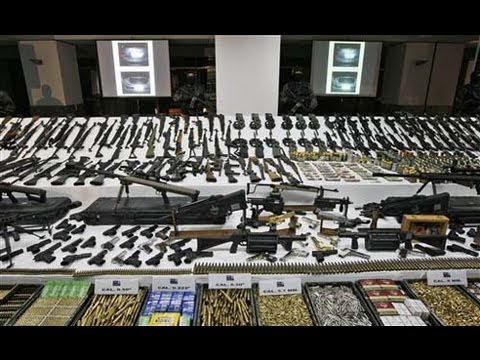
The serial numbers of many of the weapons smuggled into Chile  by the Cubans were found to be originally sent to Vietnam, and presumably captured  by the Vietcong and NVA [when they invaded the South in 1975], who were of course allies of Cuba and the USSR.
Estanislao is referring to these weapons (among others)


One of the largest discoveries of Cuban-supplied materials was at Carrizal Bajo (1986).  That was at the time considered the largest intercepted haul of smuggled weapons in Chilean history.   The Carrizal Bajo details are also well documented and available for historians.  
Or even for internet commenters. If they're hombre enough to do a little Googling. Which Estanislao doesn't appear to need, as he lived through it;
More than 3500 assault rifles were uncovered by government forces, along with more than 2000 hand grenades, and tonnes of other similar materials.  The Cubans continued sending weapons and explosives to anti-government Marxist groups such as the FPMR well into the 1980s.  And Cuban-supported operatives continued armed attacks in Chile even after the restoration of democracy, which speaks volumes about the real aims of the anti-government terrorists (some members of the democratically elected Chilean congress were targets of the Marxist FPMR, and perhaps the most famous victim of this post-restoration was senator Jaime Guzmán, and the surrounding story is readily available for anyone to study.)    I remember in our neighbourhood in southern Chile in the early 1990s when the Carabineros still had to carry Uzis around, and very openly, because of the continued threat from Marxist bandits even during the Patricio Aylwin presidency.
Hard to believe than anyone who lived in Chile at that time could be unaware of all this.